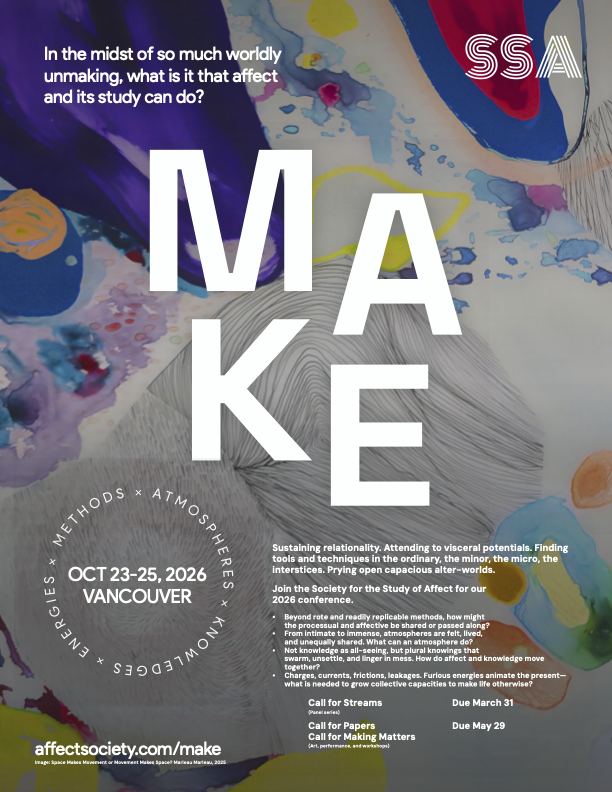
What a pleasure! I’m just returning from the 2026 Society for the Study of Affect Conference in Vancouver at Simon Fraser downtown campus and wishing the next one was sooner! I presented my research-creation project “14 Yawns: The Capacities of Boredom” amidst an amazing slew of panels ranging across the resistance politics of yeast, the modular manipulation of the Mongolian Morin Khuur, the vitality of hesitation, care and field recordings, Tai Chi, and collective individuation. It was a wealth of generous and thought provoking people and panels. Thanks to Gregory J. Seigworth, Mathew Arthur, Wendy J. Truran, Eldritch Priest, Ann Cvetkovich and the many others behind the scenes who worked tirelessly to bring this thing together.
affect
New poetry published - Capacities To: Affect Up Against Fascism /
I’ve been working on two new series, Capacities To and SPLTTD. A special issue of Capacities To from Imbricate Press published quite a few of them. It’s awesome to be in such good company.

Thanks to Gregory J. Seigworth, Mathew Arthur, Wendy J. Truran, Chad Shomura for their wonderful editing skills and their timely release of this joyful collection.
Okkyung Lee and the Insistent Forms of Affect /
Music that resists my capacity to divide, to classify its parts. Music that grabs my ears by the shoulders and shakes them, blurring all its auditory patterns into novel seams. Music that recognizes that repetition, as Gertrude Stein believed, does not exist. What we hear instead, since music can never repeat the same emphasis, is insistence.
Last night at EMPAC in Troy, New York, I had this experience of insistence listening to the noise artist and cellist Okkyung Lee. After listening intently, I thought of Eugenie Brinkema's description of affect in her book The Forms of the Affects where she extrapolates a formalist reading of affect from the tear clinging to the face of Psycho's murdered heroine in the infamous shower scene. She argues that the resistance of the tear to frameworks of representation formalizes the l'informe historically attributed to affect. The tear, in all its "tearness," writes Brinkema, insists that it is "pure exteriority of the sign of emotionality" (22). Tearness, as insistent non-representation also applies to Okkyung's performance, particularly the way in which Lee's style resists uncomplicated emotional connection and the impulse to divide her textured noises into westernized notes, phrases, or rhythms. This is not to say that it is an emotionless music, but that it is an affective music rich with sonic particularities that provoke a precise dissident intensity that insists on a life of its own. The resin smoke cloud floating in the spotlight above her frenetic glissandi was a vivid example.
I started to consider it this way. To attend carefully to Lee's performance, to practice "reduced listening," by way of Michel Chion's Audio-Vision, is to recognize that Lee's achievement deforms emotional interpretation as opposed to inviting it and thereby affirming categorical feeling. Lee's music also refolds a listener's semantic ears by sustaining its difference from perceptual frameworks. It refuses to honor the implicit contract my perception brings to it. Think of trying to locate that lid in the Tupperware drawer that will fit the jar you are holding. Lee's music thus provokes questions: Why do I want to link frenetic string work with anger?; Why am I compelled to refer Lee's thick textures to a sound I've heard before that evoked an emotion? The powerful moment she incites shows what is in the event of listening, rather than reducing the listening experience to what I habitually remove from it to "properly" hear. Alfred North Whitehead's perspective on a proper relationship to nature relates to the listening act in this affective moment. In this quote from Isabelle Stengers's A Free and Wild Creation of Concepts, I replace nature with music to approach the listening act Lee's music constructs. "The problem is not to polemicize but to accept the risk, to try the adventure, to explore what the rejection of a bifurcation of [music] obliges us to think" (40). To put it simply, I enjoyed the insistent "noiseness."
Sources
Brinkema, Eugenie. The Forms of the Affects. Durham: Duke UP, 2014.
Stengers, Isabelle. A Free and Wild Creation of Concepts. Cambridge: Harvard UP, 2011.