Thanks to Unnameable Books for hosting the HIST soundtrack premiere!
Photo courtesy of Catherine Bresner
Excerpt from “The Rescue of Hist” courtesy of Catherine Bresner
Excerpt from “The Rescue of Hist” courtesy of Catherine Bresner
Thanks to Unnameable Books for hosting the HIST soundtrack premiere!
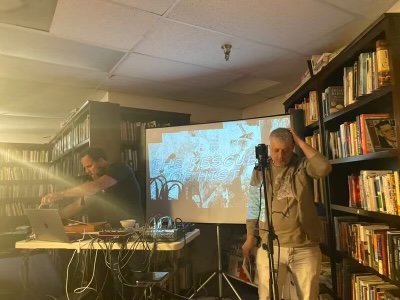
Photo courtesy of Catherine Bresner
Excerpt from “The Rescue of Hist” courtesy of Catherine Bresner
Excerpt from “The Rescue of Hist” courtesy of Catherine Bresner
Check out a new excerpt from Matthew Klane and I’s graphic novel Hist in the new Diagram 22.1. The full graphic novel is forthcoming in Summer 2022 with Calamari Archive. We’ll be designing the cover and writing a score to accompany it in the coming months. Stay tuned!

Emerging Improvisations
A Review of Paul Jaussen’s Writing in Real Time | Emergent Poetics from Whitman to the Digital

Writing in Real Time
Excerpt: In Writing in Real Time | Emergent Poetics from Whitman to the Digital, Paul Jaussen reconsiders the formal idiosyncrasies of the American long poem through contemporary systems theories. Jaussen claims that the immutable architectures that support long poems from Walt Whitman to Nathaniel Mackey cannot be reduced to the play of lyric intensities, nor are they productively approached through extensive genre categorization. Instead of these two methodologies, he argues that their forms interactively emerge; they unfold in real time as adaptive systems with the capacity to critique, rework, and respond to their changing material environments. To read the diversity of the American long poem through systems theoretical discourse is to reveal what Jaussen calls “interactive emergence,” the poet’s sustained creative/critical improvisation with the material dynamism of time.

Writing in Real Time
Emergent Poetics from Whitman to the Digital. Cambridge UP, 2017. 226 pp. $105.00 hardback.
I just finished a review of Paul Jaussen’s excellent Writing in Real Time | Emergent Poetics from Whitman to the Digital for the Journal of Modern Literature. I highly recommend it! With the Covid Pandemic, I’m not sure when this will be published, but I’ll keep you posted.
In Writing in Real Time | Emergent Poetics from Whitman to the Digital, Paul Jaussen reconsiders the formal idiosyncrasies of the American long poem through contemporary systems theories. Jaussen claims that the immutable architectures that support long poems from Walt Whitman to Nathaniel Mackey cannot be reduced to the play of lyric intensities, nor are they productively approached through extensive genre categorization. Instead of these two methodologies, he argues that their forms interactively emerge; they unfold in real time as adaptive systems with the capacity to critique, rework, and respond to their changing material environments. To read the diversity of the American long poem through systems theoretical discourse is to reveal what Jaussen calls “interactive emergence,” the poet’s sustained creative/critical improvisation with the material dynamism of time.
Enjoy this performance from my performance of Idiopathic for voice, electronics, and found sound on 2/27/20 at Green Kill Performance Space.
A great time reading with Ruth Danon at the Green Kill Performance Space on 2.13.20. Using Touchviz, I improvised video and read from an ongoing project titled With Walden. You can see other stills of the project here. I return to Green Kill on 2.27.20 to perform an except from a new sound poem called Idiopathic. Hopefully I’ll see you there!

Photo Courtesy of Bill Lessard

Photo Courtesy of Bill Lessard

Photo Courtesy of Bill Lessard

Photo Courtesy of Bill Lessard
I’m very excited to see access to the audio file of Ronald Johnson’s ARK 38 “Ariel’s Songs to Prospero” available (thanks Peter!). I was looking for this during my dissertation chapter on Ronald’s cookbooks! This is a wonderful addition to the recent reissue of Ark by Flood Editions.
Ronald Johnson's papers are held at the Kenneth Spencer Research Collection at the University of Kansas Libraries. His books are published in the U.S. by Flood Editions. Send all inquiries to peter [at] luxhominem [dot] com.
Below is a link to the recording of “ARK 38, Ariel’s Songs to Prospero,” for Dorothy Neal, recorded with Roger Gans at KQED in San Francisco in the early 1980s. It is “constructed out of recordings of songs of the birds of eastern United States,” according to Johnson.
A great find today on Ubu Web: “Toward a Sound Ecstatic Electronica: The Rationale Behind Tellus Issues “Power Electronics” and “Media Myth” by Joseph Nechvatal. Though Nechvatal originally wrote the essay for Tellus #13 in the 80s Power Electronics heyday, he revised it again in 2000. I’m impressed with how apt its notion of sound as an ecstatic critique of reductive social constructions is for today’s noise music progenitors. There is a wonderful listening list also. Check it out!
Finishing design on a Bunny Brains image gallery for Fence Digital this week. Drawn by Bunny front man Dan Seward, this will be an irreverent collection of images Dan’s been drawing and collaging digitally. I’m excited to see it out there. I think you’ll love it! Keep an eye out!